 Add us as a preferred source on Google
Last week a friend asked me why she kept downloading the wrong Cardinals app. She wanted the baseball streaming one, ended up with a university portal, and was genuinely confused that both were called “cardinal apps.” Honestly, fair enough; the name covers a lot of ground. There are cardinal apps for NFL fans, baseball fans, college students, and people managing medical supplies at home.
These apps have entirely different use cases, but they all share the same branding territory. In 2026, as global consumer spending on mobile apps exceeds $233 billion, consumers don’t have time to guess which app they actually need. This piece breaks down the most popular and well-rated ones so you know exactly what you’re getting before you hit install.
What Are Cardinal Apps?
The term cardinal apps doesn’t refer to one single product. It’s more of an umbrella, a group of mobile apps that share the Cardinal name across entirely different industries. You’ve got university tools, an NFL team app, a baseball streaming platform, and a healthcare delivery app all operating under the same word. From the UIW cardinal apps used by university students in San Antonio to the Cardinals streaming app that baseball fans use to watch games live, these are distinct products built for very different people.
Why Are Cardinal Apps Gaining Popularity?
Because people are tired of bloated, do-everything apps. A student doesn’t need a social feed mixed into their course registration tool. A Cardinals fan doesn’t need a wellness tracker; they need scores and stats. Cardinal apps tend to be narrow by design, and that’s actually the point. They focus on one audience, solve one set of problems, and mostly do it well. That kind of specificity is what makes users stick around instead of uninstalling after two days.
Benefits of Using Cardinal Apps
The honest reason people keep using these apps isn’t some polished feature list. It’s simpler; they work for what they were built for. A few things that hold across the category:
They don’t try to do too much: A student on the UIW portal gets coursework, email, and campus tools. A fan on the cardinals baseball app gets stats and scores. No noise, no distractions. Just what you came for.
Everything’s in one place: The cardinal.apps hub, for instance, pulls together Microsoft 365, the LMS, student email, and library access under one login. That’s time saved every single day for people who used to bounce between five tabs.
Updates happen in real time: Live scores, delivery tracking, game-day notifications if something changes, you find out fast. That’s especially useful during a tense ninth inning or when you’re waiting on a medical supply order.
Mobile is the priority: Most of these apps are built phone-first, not desktop-first with a mobile version bolted on. It shows in how they feel to use it.
Healthcare data is handled seriously: Cardinal Health At-Home follows HIPAA-compliant standards. For patients managing chronic conditions at home, that matters more than most features.
There’s a community side to it: The sports and university apps aren’t just utility tools; they’re built to make you feel connected to something, whether that’s a team or a campus.
So, these are the benefits that you will get from the cardinal apps if you use them in your applications. Now, let’s learn about some crucial features of these apps.
Key Features of Cardinal Apps
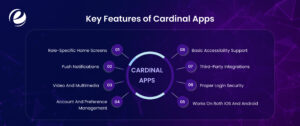
No two cardinal apps are identical, but they tend to share a few structural similarities worth knowing:
Role-specific home screens: You see what’s relevant to you as a student, fan, or patient, not a generic dashboard.
Push notifications: Information that actually matters, not just marketing pings but game alerts, assignment deadlines, and delivery confirmations.
Video and multimedia: The coursework videos that are baked in live streaming, highlights, and recorded content, depending on the platform.
Account and preference management: It helps in managing your account so your settings follow you across sessions.
Works on both iOS and Android: Scalable for both users so no one’s being left out based on their phones.
Proper login security: It provides a secure interface, especially for apps touching medical records or academic data.
Third-party integrations: For ticketing systems, Microsoft tools, and healthcare networks.
Basic accessibility support: Screen reader compatibility and text sizing are still underrated and worth mentioning.
These features depend on the industry and region in which you are using the cardinal apps.
Top Cardinal Apps You Should Know in 2026
After learning the basics about the cardinal apps, now let’s look at some of the most popular apps that users use in their everyday lives to make things more manageable.
UIW Cardinal Apps
The UIW cardinal apps setup is designed for the University of the Incarnate Word community students, staff, and faculty based in San Antonio, Texas. The my cardinal apps portal is the main hub. From there, you can handle course registration, check financial aid status, access campus event info, and pull up academic records.
The cardinal.apps platform ties all of it together: Microsoft 365 tools, student email, the learning management system, and library resources: one login, one place. For a student juggling a full course load, that kind of consolidation isn’t just convenient; it’s genuinely useful. Worth noting too: the cardinal sounds app is part of this UIW digital ecosystem, adding an audio and community layer to the campus experience.
Arizona Cardinals Mobile App
The official cardinal app for the Arizona Cardinals is what you’d expect from an NFL team’s first-party app and then some. Live game tracking, injury updates, depth charts, and team news as it breaks. Fans also get exclusive video, ticket purchasing, Cardinals Radio, and merchandise access all in one place. Fantasy football integrations are there too if that’s your thing. It’s rated consistently above 4 stars on both stores, which for a team app is genuinely impressive. Game day with this open is a different experience than refreshing a sports website.
Cardinals.TV
Cardinals.TV app, depending on how you’re searching for it, is the St. Louis Cardinals’ own streaming platform. You can also think of it as the Cardinals streaming app that cuts out the middleman. Live games, post-game breakdowns, archived matchups, and Cardinals Network programming; it’s all there.
As more fans ditch cable, the app has become a legitimate primary option rather than a supplement. The cardinals.tv app runs on mobile, tablet, smart TV, and desktop. If you’re a serious St. Louis fan and you don’t have the app, that’s probably the gap.
MLB Ballpark App
The cardinals ballpark app is your stadium companion. Powered by MLB’s official Ballpark platform, it’s built specifically for game day at Busch Stadium, with mobile ticketing, seat upgrade options, navigation inside the park, food ordering from your seat, and in-park promotions.
The cardinals baseball app side of it also handles player stats and standings outside of game day, so it earns its space on your phone year-round. It consistently ranks well on both the App Store and Google Play, and the food ordering feature alone has saved more than a few people from missing a big play while standing in a concessions line.
Cardinal Health At-Home App
This one’s different from the rest less about sports or school, more about making healthcare less of a hassle. Cardinal Health’s at-home app serves patients with chronic conditions who depend on home delivery of medical supplies. You can place orders, track what’s coming, manage prescriptions, and reach support without setting foot in a clinic or pharmacy.
It connects directly into Cardinal Health’s home care network, which makes it particularly useful for elderly patients or anyone with limited mobility. Caregivers and healthcare providers can also manage patient accounts through it. The data handling meets HIPAA standards that’s not a bonus feature; it’s a basic requirement for this kind of app, and they meet it.
Cardinal Apps Use Cases for Individuals and Businesses
These apps pull weight in different ways depending on who’s using them. Below you will learn the use cases on the basis of individuals and businesses:
For Individuals
Students lean on my cardinal apps for everything from first-day enrollment to senior year graduation checks; they follow them through the whole academic cycle. Sports fans use the Cardinals streaming app and the ballpark app depending on whether they’re watching from a couch or sitting in section 148. Patients and caregivers use the Cardinal Health At-Home app to handle supply logistics without the friction of phone calls and clinic visits.
For Businesses and Institutions
Universities use the cardinal.apps portal to digitize student services and cut down on administrative back-and-forth. Healthcare systems use Cardinal Health’s platform to manage delivery logistics and keep patient communication organized.
Sports franchises treat their app ecosystems as revenue channels merchandise, tickets, and subscriptions and direct fan relationships matter a lot in a market where global app revenue is projected to hit $633.71 billion in 2026. Media companies building around streaming apps are doing the same thing creating owned channels rather than renting attention on someone else’s platform.
Challenges and Limitations of Cardinal Apps
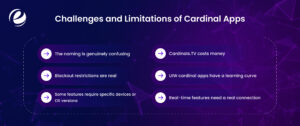
They’re good apps. But they’re not perfect, and a few things are worth flagging before you commit. Below you will learn about some challenges that you should overcome for the cardinal apps usage:
The naming is genuinely confusing: “Cardinal apps” covers a university, two sports franchises, and a healthcare company. If someone searches without knowing exactly what they want, they will download the wrong thing. This has happened.
Blackout restrictions are real: The cardinals tv app runs into broadcasting blackout rules in certain regions. If you’re in a local market, your subscription may not give you full access to live games.
Some features require specific devices or OS versions: Stadium tools, especially, don’t always behave well on older phones or outdated software.
Cardinals.TV costs money: Premium streaming isn’t free, and for casual fans, the subscription cost might not feel worth it outside of the regular season.
UIW cardinal apps have a learning curve: For first-time college students who aren’t used to integrated academic portals, it can take a week or two to figure out where everything actually is.
Real-time features need a real connection: Live scoring, delivery tracking, and in-stadium tools all fall apart without a stable internet connection. It’s worth remembering this before you assume it’ll work on 1-bar LTE at a packed stadium.
Thinking About Building Your Own App Like Cardinal Apps?
If you’ve been reading this and thinking “we should have something like that” for your team, your school, your healthcare org, whatever it is, that’s a reasonable reaction. What makes cardinal apps work isn’t magic. It’s focused. They pick an audience, build around that audience’s actual behavior, and leave out everything else. That’s a replicable model. What it requires is a development partner who actually understands the niche you’re building for, not just someone who can write code.
How to Develop an App Like Cardinal Apps?
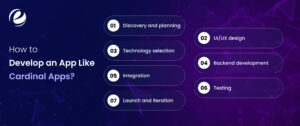
Good apps don’t come from a checklist. But the process behind them usually follows a recognizable path and knowing that path helps you avoid the expensive mistakes:
Discovery and planning: Get specific before you get technical. Who’s using this? What are they doing when they open it? What do competing apps get wrong? For a sports app, that might mean fan engagement gaps; for a university app, it might be fragmented logins and outdated portals.
UI/UX design: Wireframes and prototypes before any code gets written. You main goal must be a user journey that makes sense fast to load, easy to navigate, and built for how people actually use phones rather than how designers imagine they do.
Technology selection: Native (Swift for iOS, Kotlin for Android) gives you the best performance and access to hardware features. Cross-platform frameworks like React Native or Flutter get you to market faster with less budget. The right answer depends on your users and your resources.
Backend development: This is where the app actually lives user accounts, notifications, content delivery, and integrations. For a streaming app, add CDN setup and adaptive bitrate delivery to that list. Don’t underestimate this layer.
Integration: Most cardinal-style apps don’t build everything themselves; they connect to ticketing platforms, Microsoft 365, healthcare networks, or the MLB API. Getting those integrations right takes experience with the specific systems involved.
Testing: QA on real devices, real network conditions, and real usage patterns. Live streaming apps at peak load during a playoff game are a different animal than a casual-use tool. Test accordingly.
Launch and iteration: The first version is never the final version. Watch what users do, not what they say in reviews, and adjust based on actual behavior data in the first 30 to 60 days.
A team with genuine experience in mobile app development will push back on the right things and build for the long run, not just the demo.
Why Choose Emizentech for Custom Media App Development?
Emizentech builds mobile and digital products across industries such as sports, entertainment, healthcare, and education, and our developers have the experience to know where the typical pitfalls are. If you want to build something in the cardinal apps category or adjacent to it, here are a few things to know about working with us:
-
We handle the full build strategy, design, development, QA, post-launch so you’re not coordinating between three separate vendors
-
You can hire mobile app developers on a flexible basis depending on what your project actually needs
-
Our experts have real video streaming app development experience, not just the front end but also the infrastructure behind live and on-demand content
-
Architecture is built to scale, not just to pass a demo
-
Communication is straightforward, not a lot of jargon, regular updates, no surprise pivots
Whether you’re building a fan app, a campus tool, or a patient-facing healthcare product, Emizentech is worth a conversation early rather than after you’ve already gotten the scope wrong somewhere else.
Conclusion
Cardinal apps aren’t a category in the traditional sense; they’re a collection of very different products that happen to share a name and a common philosophy: build for one group of people and do it well. Whether you’re a UIW student working through the cardinal.apps portal at 11pm before a deadline, a baseball fan streaming a Cardinals game through the cardinals tv app, a patient tracking a medical supply order from home, or someone heading into Busch Stadium with the MLB Ballpark app ready on their phone there’s a specific tool that was built for your situation. In 2026, that kind of focus is what separates apps people actually keep from the ones they delete after a week.
FAQs
1. What are cardinal apps and who are they for?
Cardinal apps refer to several different mobile tools sharing the Cardinal name, covering a university portal, NFL and MLB team apps, and a healthcare delivery platform. Each one targets a specific group: students, sports fans, or patients managing care at home.
2. Is Cardinals.TV the same as the Arizona Cardinals app?
No, completely different teams, different sports. Cardinals. TV is the St. Louis Cardinals baseball streaming platform. The Arizona Cardinals app is for the NFL franchise in Phoenix and covers game tracking, tickets, news, and fan content.
3. Can I access UIW cardinal apps on mobile?
Yes. The UIW cardinal apps system including the my cardinal apps portal and the cardinal.apps hub works on mobile through a browser and supported apps. Students and faculty can access email, courses, and campus tools from their phones without needing a laptop.
4. How do I build an app similar to cardinal apps?
Start by getting clear on your audience and what they actually need to do inside the app. Then work with a development team that has experience in your specific category, sports, healthcare, or education, not just mobile development in general. Focused apps win. Feature bloat is what kills apps.