- Chat
-
Call
Emizentech Contact USA: +1 (989) 535-9295 UAE: +971 58 587 6283 IND: +91-8529003877 Career/Openings IND: +91-9602561777
- Emizen AI
- Company
-
Services
- Mobile App Development
- Wearable App Development
- Android App Development
- iOS App Development
- Hybrid App Development
- Flutter App Development
- React Native App Development
- Enterprise Ecommerce
- Software Development Services
- Software Testing & QA
- Web Development Services
- Web Designing
- Healthcare Software Development
- CMS Development Services
- CRM Software Development
- ERP Software Development
- Data Analytics Services
- IoT Development Services
- Low Code / No Code Development
- Software Testing & Quality Assurance Service
- Technologies
-
Industries
- Retail Software
- Food Delivery App
- Automotive
- Media & Entertainment
- Ticketing & Event
- Real Estate
- Fitness App Development
- Logistic & Transport
- Education App
- Fintech Software
- Sports
- Fantasy Sports
- Gaming App
- Golf Mobile App
- On-Demand
- Dating App
- Petcare App
- Video Streaming App
- Travel App
- Social Media App
- Startup App
- Car Service App
- Fantasy Football App
- Loyalty App
- Salon App
- Lawyer App
- Onlyfans App
- Grocery App
-
Hire Developers
- Hire Android Developers
- Hire Mobile App Developers
- Hire Web Developers
- Hire Dedicated Developers
- Hire Ecommerce Developers
- Hire Shopify Developers
- Hire Shopware Developers
- Hire Odoo Developers
- Hire Servicenow Developers
- Hire Salesforce Developers
- Hire Python Developers
- Hire Strapi Developers
- Hire Google Cloud Developers
- Hire iOS Developers
- Hire React Native Developers
- Hire React Developers
- Hire Laravel Developers
- Hire PHP Developers
- Hire Drupal Developers
- Hire Xamarin Developers
- Hire CakePHP Developers
- Hire Power BI Developers
- Hire Ruby on Rails Developers
- Hire ASP.NET Developers
- Hire CodeIgniter Developers
- Hire WooCommerce Developers
- Hire BigCommerce Developers
- Hire Ionic App Developers
- Hire Node.js Developers
- Hire WordPress Developers
- Hire AngularJS Developers
- Hire Full Stack Developers
- Hire Java Developers
- Hire Magento Developers
- Hire Hybrid Developers
- Hire BigCart Developers
- Hire osCommerce Developers
- Hire Joomla Developers
- Hire OpenCart Developers
- Hire PrestaShop Developers
- Blog
Odoo VS SAP: Everything You
Need to Know!
Are you at a turn in your entrepreneurial growth, wondering, “Which enterprise software would produce real results, Odoo vs SAP?” This choice is a turning point with terribly high stakes for the future of your very enterprise. As the market is undergoing rapid changes in this era, the new-age corporations crave solutions that drive their operation with profits and sustainability.

The ultimate guide to SAP vs Odoo for you, a proficient decision maker! At Emizentech, we don’t implement technology; we implement change. If you are looking for Odoo’s flexible scalability or SAP’s powerhouse capabilities, this blog will clearly explain everything you need to know to make your next move more powerful.
From cost considerations to integrations like Shopify, SAP integrations, and Odoo Ecommerce development, we are present at your service to help you make a game-changing decision and partner with those experts who put your growth first. Come, let’s find the perfect ERP to prepare your business today for leadership, innovation, and winning!

Market Stats for Odoo (2025–2030)
The Odoo customisation and services market size is expected to jump from $1.3 billion in 2024 to $3.1 billion by 2030, representing a significant CAGR of 14.2%. This boom will continue to be dominated by the rapid growth of SMEs, tech-driven digital transformation, and the proliferation of cloud-based ERP solutions that are more agile and versatile. The highest growth is spotted in areas like Asia-Pacific (CAGR 16.7%) and North America (CAGR 13.5%).
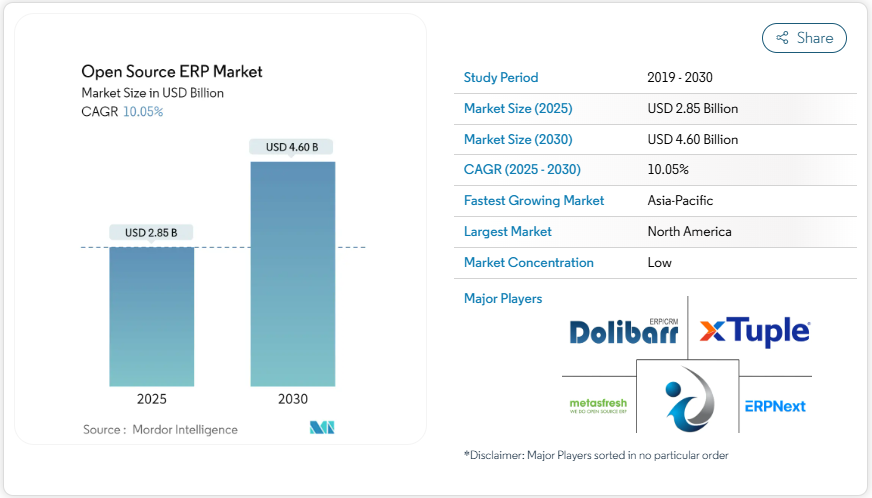
Additionally, as per Mordor Intelligence, the open-source ERP market is predicted to broaden from $2.85 billion in 2025 to $4.60 billion by 2030, which means that Odoo plays a significant role in this segment.
Market Stats for SAP (2025–2030)
According to Maximize Market Research, the SAP Digital Services Ecosystem, which includes ERP, CRM, and related technologies, is expected to increase from $95.3 billion in 2023 to $162.28 billion by 2030 at a CAGR of 7.9%. One more estimate says that SAP’s corresponding market size will be $154.44 billion by 2030, and it will grow by a 6.79% CAGR.
SAP’s global ERP market share is still significant, with the total ERP software market expected to hit $123.41 billion by 2030, fueled by the need for data-driven and cloud services.
Overview of Odoo and SAP
Odoo and SAP are well-known ERP systems that automate core business functions. Odoo is quite flexible and user-friendly, which makes it suited for small and medium-sized businesses, while SAP is more powerful and feature-rich for big organizations with complex requirements.
Odoo
Odoo is an incredibly flexible, open-source ERP that is known for its modularity and user-friendliness. It is suitable for small and mid-sized businesses that are planning to buy flexible and low-cost business management software.
Odoo allows users to start with core modules such as sales, CRM, and accounting, and then scale up as required, helping customers cope with specialized tasks such as Odoo e-commerce development, as well as customized Odoo ERP for industries. Its simple interface and low budget make Odoo the best choice in the Odoo vs SAP comparison.
Odoo: Key Highlights
- In the Odoo vs SAP discussion, Odoo is an open-source software that is highly customizable for changing business needs.
- It is low-cost and straightforward and intended for SMBs that want to use industry-specific solutions such as Odoo ERP for their industries.
- Modular design allows for simplicity in integrating additional services like Odoo e-commerce development.
SAP
SAP stands out as a powerhouse in the ERP world, offering robust enterprise-grade software solutions for big companies and world organizations. Known for its in-depth industry specialization, SAP is the provider of the analytics, compliance, and localization capabilities that fit perfectly for complicated businesses with global operations.
SAP’s right integration ecosystem, including Shopify SAP integration, is perfect for those organizations that are still searching for a comprehensive process automation and connectivity solution. SAP is often the winner in the SAP vs Odoo contest when it comes to enterprises that are looking for the platform with the most advanced functionality and scalability.
SAP: Key Highlights
- Robust enterprise functions that best fit complicated organizations in the Odoo vs SAP comparison.
- High-level connecting system, including Shopify SAP integration, for up-to-date operations.
- Profound industry focus and compliance, enabling multinational business operations.
SAP vs Odoo: A Feature-by-Feature Comparison
Choosing a proper ERP can determine a business’s success or failure. In the grappling of SAP vs Odoo, the conclusion comes down to choosing the one that meets your needs, has a compatible price, and is suitable for your business scale. Here, we examine the main characteristics of both so that you can make a proposal with confidence and knowledge.

Customization
Odoo is very customizable, giving businesses the freedom to add/modify the modules according to their growth easily.
SAP is also a flexible system, however, customization might take more time, require more money and more expertise.

Implementation Speed
Odoo typically provides quicker implementation, which is perfect for small and medium businesses that need results fast.
SAP implementations are complicated and can consume more time, but they fit large, global companies better.

Cost
Odoo is more affordable and has fewer licenses and installation costs, which makes it reachable for startups and SMEs.
SAP has higher initial costs due to its enterprise features.

Integration Capabilities
Both systems interface with third-party applications, but SAP leads the pack in sturdy, enterprise-level integrations- especially when it comes to Shopify.
Odoo also leads the charge, especially for eCommerce businesses looking for smooth integrations at a reasonable price.

User Experience
Odoo features a clean, contemporary, and user-friendly interface, probably because most users prefer it to be up quickly.
SAP is all about great dashboards and analytics, but it does take some extra training for teams to get into.
- Both offer great functions, and the main choice between Odoo vs SAP would depend on the size of your business, processes, and future growth plans.
Odoo vs SAP:Feature Comparison
| Aspect | Odoo | SAP |
| Cost | Lower setup and maintenance costs | Higher upfront and maintenance costs |
| Flexibility | Highly customizable, modular | Extensive, powerful but less flexible |
| Industry focus | Broad, with specialized add-ons | Strong industry-specific solutions |
| Implementation | Faster, easier for SMEs | Longer, in-depth for large enterprises |
| Usability | Modern, intuitive UI | Complex, requires specialized training |
How To Choose the Right ERP For Your Business?
Choosing the right ERP (Enterprise Resource Planning) system is probably one of the biggest decisions a company can make. A good product not only helps you to make your work more efficient but also supplies your business with growth potential.
But with a multitude of systems on the market, how can you choose the one which would be most suitable for your business? Here are a few important tips which will lead you to the right choice without any doubts.
List Your Business Needs
Firstly, try to find out what is going on in your business currently, in terms of stages and challenges and the set goals. Specify the features and processes that you want to introduce to your business and improve. Make sure to gather ideas and opinions from different team members so that nothing important is missed.
Set a Realistic Budget
Be careful and consider all other things apart from just the direct cost of the software. Apart from the software price, you will need to pay for the setup, training, support, and updates. Drawing up a budget at the beginning will save you from getting into trouble due to unexpected costs.
Check for Industry Fit
Search for ERP software that has been used by similar businesses in your industry or systems that have the same main function as you and have specialized modules. The closer the match, the less you’ll spend on customization, and the better your results will be.
Ensure Easy Integration
Your ERP should be easily connectable with your current tools, such as accounting, manufacturing, or eCommerce software, without any issues. This not only avoids disruption but also helps your business run more efficiently.
Evaluate Vendor Support
Select a provider with whom you can trust, who can give you access to training and periodic updates, and who can respond promptly to your technical supply challenges. Great support during the entire period is the key to the success of the ERP system.
ERP Cost Comparison? How to Avoid Paying More Than You Need?
Smart business decision-makers must understand ERP costs. These can range widely, but you don’t have to pay more than you need. A solution can be identified with a feature-for-feature comparison of ERP costs and knowing the drivers of the pricing.

Define Your Core Requirements
List only those features your business needs. Say no to costly options if they add. This will keep the focus on the essentials of ERP investment.

Choose the Right Deployment (Cloud vs. On-Premise)
The Cloud has lower up-front costs and flexibility in monthly billing. On the other hand, installations and hardware for on-premise can be hefty up-front expenses. It really depends on what fits your size and cash flow best.

Negotiate Licenses Wisely
It is advisable not to give everyone full access in your company. Allow licenses only to those who will be using the software and seek other options for scalable licensing as your business grows.

Budget for Implementation and Support
The price for installation sometimes surpasses the price for the software itself. Consider the time for training, customisation, and support down the road when comparing costs. Avoid surprise expenses by making sure these have not been left out.

Review Integration Needs Early
Usually, integrations with a CRM or eCommerce add to the total cost of an ERP system. Make sure the system supports easy integrations with almost no extra cost- a must for companies needing Shopify SAP integration or Odoo E-commerce development.
ERP Cost Comparison Table (USD)
| ERP System | Cost per User/Month ($) | Implementation Cost Range ($) | Best For |
| NetSuite ERP | 125 | 10,000 – 100,000 | Small & Mid-Sized Businesses |
| SAP S/4HANA | 200+ | 75,000 – 500,000+ | Large Enterprises |
| Microsoft Dynamics 365 | 175 | 35,000+ | MS-Driven Businesses |
| Epicor Kinetic | 125 | 50,000 – 500,000 | Manufacturers |
| Infor CloudSuite | 150 | 25,000 – 500,000 | Midsize & Large Organizations |
| Acumatica | Consumption-based | 10,000+ | Growing Businesses |
| Cetec ERP | 50 | 3,000 – 40,000 | Manufacturing Businesses |
Why is Emizentech the Ultimate Game-Changer in Your ERP Journey?

Your ERP success depends on your implementation partner: your choice can redefine the entire journey. At Emizentech, we’re not only the suppliers of the technology but also the ones who stand by your side in the whole growth process. Our team is very warmhearted in understanding that each company is different, and that’s the reason why we not only provide Odoo and SAP solutions but also customize them according to your exact requirements.
We don’t just do the technical setup; we are the ones who collaborate, guide, and change our method in such a way that your ERP journey becomes maximum value-driven. We understand that embracing an ERP with a great capacity like Odoo or SAP is a decision for a long duration.
This is where our knowledge and practical support really affect the situation, starting with the first consultation and going on with the optimization of the work. Our mission is to help your business thrive with seamless technology.
- The first step of our method is always to understand your goals, challenges, and industry requirements; therefore, the solution we give will actually fit your business.
- If you are looking for a Shopify SAP connection, Odoo Ecommerce creation, or some kind of ERP modules for a particular industry, we will specify every detail with full accuracy.
- We provide full training and also round-the-clock service. We are there for you even long after go-live because a successful ERP partnership still remains after deployment.
- Our flexible solutions and proactive guidance will keep you on the cutting edge, always as your needs change.
When you choose Emizentech as your ERP partner, it means that you are going beyond technology and getting a devoted team that is dedicated to improving your business by making it more intelligent, efficient, and sustainable. Let’s build your transformation story together!
Conclusion
FAQs
What is the main difference between Odoo and SAP?
Odoo is flexible with modular architecture, translating to affordability and a wide domain of small and mid-size businesses. SAP is a full-fledged enterprise-grade ERP developed for big organizations, offering industry-specific features and strong analytics.
Which ERP is better for small businesses, Odoo or SAP?
Odoo is best for small businesses because of its lower cost, shorter implementation period, and ease of use. SAP is meant for big businesses with numerous complex processes and operations across vast locations.
How long does it take to implement Odoo or SAP?
In most cases, an Odoo implementation is short and sweet, going from a few weeks to a couple of months; this is because it requires thorough requirements gathering and customization. SAP implementations take months to even a year, depending on how complex and vast it is.
How much does it cost to implement Odoo or SAP?
According to your business size, the amount of customization you want, and the kind of deployment you want, the costs vary. Most of the time, with less upfront and ongoing cost, there is Odoo. SAP, at a high price, offers gigantic capabilities targeted toward Enterprises. Emizentech will help you find the best value solution customized to your budget.
Why should I choose Emizentech as my ERP partner?
Emizentech customizes your implementation of Odoo and SAP as per your needs. We provide end-to-end support and bring deep industry expertise, along with proven experience in systems integration, to help translate an ERP investment into real business growth.

- Mobile app development
- Mobile app
- app development
- Mobile app development
- Mobile app development
- Mobile app development
- Mobile development
- Mobile app development
- Mobile app development
- Mobile development
- Mobile app development
- Mobile app development
- app development
- Mobile app development
- Mobile app
Copyright © 2013 - 2025 Emizentech . All Rights Reserved. Privacy Policy

Privacy Overview
| Cookie | Duration | Description |
|---|---|---|
| cookielawinfo-checkbox-analytics | 11 months | This cookie is set by GDPR Cookie Consent plugin. The cookie is used to store the user consent for the cookies in the category "Analytics". |
| cookielawinfo-checkbox-functional | 11 months | The cookie is set by GDPR cookie consent to record the user consent for the cookies in the category "Functional". |
| cookielawinfo-checkbox-necessary | 11 months | This cookie is set by GDPR Cookie Consent plugin. The cookies is used to store the user consent for the cookies in the category "Necessary". |
| cookielawinfo-checkbox-others | 11 months | This cookie is set by GDPR Cookie Consent plugin. The cookie is used to store the user consent for the cookies in the category "Other. |
| cookielawinfo-checkbox-performance | 11 months | This cookie is set by GDPR Cookie Consent plugin. The cookie is used to store the user consent for the cookies in the category "Performance". |
| viewed_cookie_policy | 11 months | The cookie is set by the GDPR Cookie Consent plugin and is used to store whether or not user has consented to the use of cookies. It does not store any personal data. |